• Welcome to Jetboaters.net!

    We are delighted you have found your way to the best Jet Boaters Forum on the internet! Please consider Signing Up so that you can enjoy all the features and offers on the forum. We have members with boats from all the major manufacturers including Yamaha, Seadoo, Scarab and Chaparral. We don't email you SPAM, and the site is totally non-commercial. So what's to lose? IT IS FREE!

    Membership allows you to ask questions (no matter how mundane), meet up with other jet boaters, see full images (not just thumbnails), browse the member map and qualifies you for members only discounts offered by vendors who run specials for our members only! (It also gets rid of this banner!)

    free hit counter

Our Installed Solar ~ 252 FSH

I think you're over complicating the purpose of the dc to dc charger.

It is simply a back up charging system. That's it, nothing more.

We've run this system on multiple guide boats and it works perfect for what it is.

When the house runs low and you can't fire your mains up (shallow water or what have you). Kick on the charger and boost the system.

This is precisely what dc to dc chargers are for.

Charging one battery system from another.
 
I think you're over complicating the purpose of the dc to dc charger.

It is simply a back up charging system. That's it, nothing more.

We've run this system on multiple guide boats and it works perfect for what it is.

When the house runs low and you can't fire your mains up (shallow water or what have you). Kick on the charger and boost the system.

This is precisely what dc to dc chargers are for.

Charging one battery system from another.
No not at all.

I was pointing out how to get more out of your house battery by using recognized standard proper charging and maintenance procedures on deep cycle lead acid batteries while on shore power to increase the storage capacity of up to 25%, setting up the DVSR properly so you’re not trying to charge the start battery at the same time you’re charging the house battery with your DC to DC system, and how using a LFP battery of the same footprint of a group 24 FLA battery would double the battery storage capacity you currently have, further, going to a group 27/31 100Ah LFP would triple your battery storage capacity and reduce the weight of your current group 24 battery by 50%, you’ve achieved the same thing with your LFP trolling motor battery.

A lot of people use DC to DC chargers to charge their house batteries from their start batteries of equal voltage as they function as an ACR, others who’s boats have automotive style alternators, Variable Magnetic Alternators, that are not thermally protected are able to charge their LFP batteries at a limited rate to protect their VMA alternators, as well as your application of using the DC to DC charger to charge your 12V house battery from your 36V troller battery. The alternators in our boats which are PMA, Permanent Magnetic Alternators are a great marriage for LFP battery charging since they’re always at full output and unwanted voltage / current is shunted to ground, couple that with a LFP battery’s low resistance and five times faster charging rate and you have a great exploitation of our boats limited charging system. Each engine is capable of roughly 13-14A each of output.

As a suggestion, you could add another smart shunt to your house FLA house battery so you KNOW how many Ah’s / KWhs you’ve pulled out of it, and what the actual / accurate SOC is on the battery. The SOC will update as you employ your DC to DC charging system or when you are running your engines. Using voltage, especially the voltage from the connext screen which is notoriously low to measure FLA battery capacity is not at all accurate due to FLA batteries poor pukert effect numbers and lead most people to think their FLA battery is depleted when it is not. The voltage readings from the smart shunt are spot on, I have two of them on my boat and I’ve checked them both with a calibrated digital multimeter and the smart shunts voltage readings are at a minimum .5 volts higher than the connext screen which is probably due to a zener diode in the connext system.
 
Eventually i'll swap the house out to Lith, but for now its new so no hurry, when it dies i will....
 
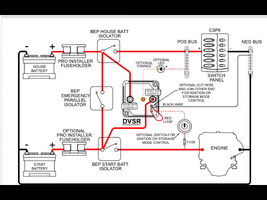
Here’s the line diagram for the DVSR

IMG_5622.png

Here’s the link on how the DVSR works and how to modify the red wire for the different operating modes
 
I know how the dvsr works and how to accomplish the mod. It was way easier to just connect two wires the house... Thanks
 
Yo
I know how the dvsr works and how to accomplish the mod. It was way easier to just connect two wires the house... Thanks
You are welcome!
 
Back
Top