FSHER
Jet Boat Lover
- Messages
- 43
- Reaction score
- 26
- Points
- 77
- Location
- Tampa, FL
- Boat Make
- Yamaha
- Year
- 2021
- Boat Model
- FSH Sport
- Boat Length
- 21
Good day,
I find the lack of engine gauges to be lacking in my 2021 FSH 210 and would like to poke brains for possible solutions. I'm looking at potentially 3 problems to solve. its likely overkill and I have not thought it all through. I just feel like I have no idea what's going on with these engines and no way to tell until there is a bigger problem.
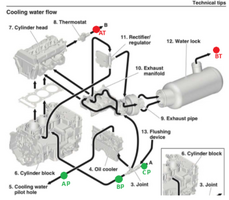
First id like to find a way to monitor either pressure or flow from the cooling water coming in or out of the engine., whichever makes more sense. This could be a check value or something like that indicating either yes there is flow/pressure or no. I boat in Florida on the salt water and we have periods of massive amounts of turtle grass and in the no wake zones it doesn't take much to clog up the intake and over heat the engines. first ill lose cooling water then ill get the overheat alarm. it would be nice to know that the cooling water has stopped flowing before i get the overheat alarm. there's no indication until the overheat alarm. I made a few points on the diagram that may look interesting. I'm thinking for this squawk point "CP" would make the most sense.
second id like to measure the temperature of the cooling water at whatever point in the system that would make the most sense. This would be great to be able to know what the normal operating temps are and be able to compare the 2 engines. Maybe after the thermostat would be a good spot at point "AT"
Lastly, recently, a portion of my exhaust melted off due to hot exhaust gases not having enough cooling water mixed in that was caused by a hole in a leaking wet pipe. likely a rare issue but I I would really like to be able to monitor exhaust gas temp or the exhaust water temp or something along those lines. these would be another one that I would like to be able to just look down and do a quick side by side comparison between the engines. not sure where or how on this one because i believe a sensor would need to be placed pretty far down stream, maybe right at the exit port on the top of the water lock?
I did see that someone put a temp gauge on the pilot/pisser other then that my research comes up with nothing.
as these bad ideas? has anyone done anything like this? curious on your thoughts.
-Mark
I find the lack of engine gauges to be lacking in my 2021 FSH 210 and would like to poke brains for possible solutions. I'm looking at potentially 3 problems to solve. its likely overkill and I have not thought it all through. I just feel like I have no idea what's going on with these engines and no way to tell until there is a bigger problem.
First id like to find a way to monitor either pressure or flow from the cooling water coming in or out of the engine., whichever makes more sense. This could be a check value or something like that indicating either yes there is flow/pressure or no. I boat in Florida on the salt water and we have periods of massive amounts of turtle grass and in the no wake zones it doesn't take much to clog up the intake and over heat the engines. first ill lose cooling water then ill get the overheat alarm. it would be nice to know that the cooling water has stopped flowing before i get the overheat alarm. there's no indication until the overheat alarm. I made a few points on the diagram that may look interesting. I'm thinking for this squawk point "CP" would make the most sense.
second id like to measure the temperature of the cooling water at whatever point in the system that would make the most sense. This would be great to be able to know what the normal operating temps are and be able to compare the 2 engines. Maybe after the thermostat would be a good spot at point "AT"
Lastly, recently, a portion of my exhaust melted off due to hot exhaust gases not having enough cooling water mixed in that was caused by a hole in a leaking wet pipe. likely a rare issue but I I would really like to be able to monitor exhaust gas temp or the exhaust water temp or something along those lines. these would be another one that I would like to be able to just look down and do a quick side by side comparison between the engines. not sure where or how on this one because i believe a sensor would need to be placed pretty far down stream, maybe right at the exit port on the top of the water lock?
I did see that someone put a temp gauge on the pilot/pisser other then that my research comes up with nothing.
as these bad ideas? has anyone done anything like this? curious on your thoughts.
-Mark