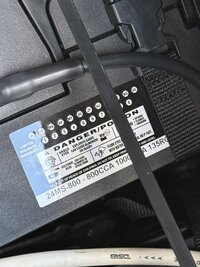
I have a 2023 Yamaha 222SD. I currently have 2 lead acid batteries one for starting and one for house. Also a factory BEP DVSR switch. Can I change my house battery to a AGM deep cycle and keep the starting battery as lead acid to get the higher CCA? Will there be any problem with charging from the alternator with two different battery types?
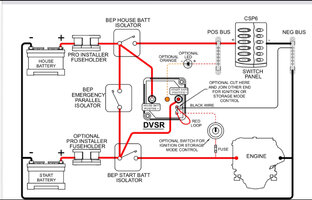
A quick primer on the BEP battery switch and DVSR.
When the boat is not being used, the Start, House and Emergency parallel // switches are in the off position.
When the boat is being used, the Start and House battery switches are on, and left on while the boat is in use, and the Emergency // switch is left off.
The Emergency // is only used as a way to boost the start battery if it is too low to start the engines.
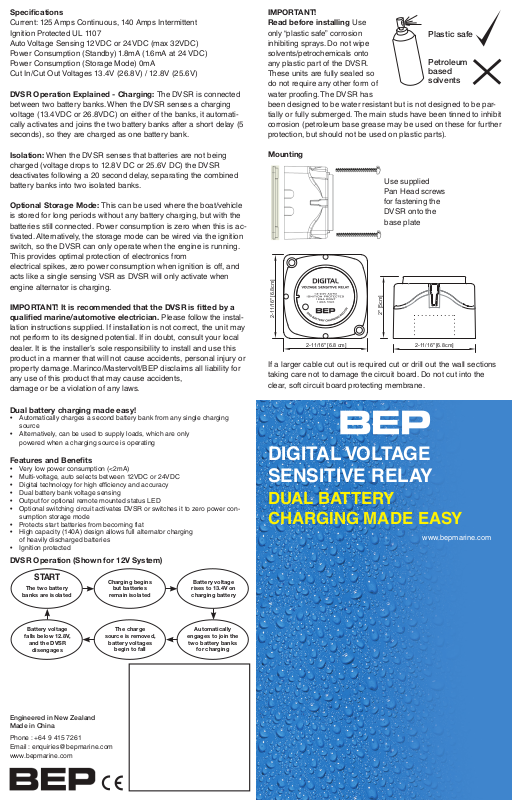
The DVSR ( Digital Volt Sensing Relay) closes the movable contact paralleling // the Start and House battery when voltage on either battery reaches 13.4 volts. When the voltage drops to 12.8 volts the DVSR opens the movable contact breaking // between the Start and House batteries, this keeps the start battery isolated from house or accessory loads so that it is fully charged and ready to start the engines.
The batteries come wired so that the engine cables are attached to the engines for starting, and as a result the start battery charges first before the DVSR closes at 13.4 volts and begins also charging the house battery. This is the primary strategy of the DVSR, to keep the start battery isolated from house loads and ready to start the engines.
The DVSR comes wired in automatic mode, meaning it is always active, so when an onboard battery charger fed from shore power is used and the voltage is raised as a result of the batteries being charged the DVSR will close // the Start and House batteries, which is not conducive to proper deep cycle battery-House battery charging, nor start battery charging. There are two other modes available with the DVSR, Storage and Ignition Hot. The storage mode configures the DVSR so that it is inactive when the battery switches on the DVSR are turned off. The Ignition Hot mode configures the DVSR so that it is only active while the engine(s) are running. The latter of which is easily accomplished by attaching the red wire on the back of the DVSR module to a fuel pump positive or hot wire, several members here have done this modification with great success and is arguably the best way to set up the DVSR so that the Start and House batteries are always isolated whenever the engines are off.
The charge controllers, the rectifier / regulator that converts the AC voltage from the alternators to DC and the regulates the output from your engines and charge the batteries to 14.4 volts.
The resting voltage on a flooded lead acid battery is slightly lower than an AGM (also a lead acid battery). Therefore, the AGM battery will discharge slightly into the start battery when the engines are off thereby taking away some of its storage capacity. Speaking of storage capacity, look very closely at the charts or tables, what I’ve found is that most of the time a flooded lead deep cycle house battery has more energy storage capacity than an AGM. The big advantage to an AGM is its a no maintenance battery with slightly higher voltage, while as you noted the flooded lead acid can deliver better cranking voltage. On the subject of higher cranking amperage, cranking amperage has been measured on the 1.8 L engines to be roughly 80 amps. I run an Interstate dual purpose Group 24 AGM battery for my start battery and it has performed great over the past four years.
It should also be said that our boats have small alternators that only produce 13-14 amps per engine, these alternators are unlike the alternator in a car, they’re permanent magnet alternators which means they will start charging a very low battery as soon as the engines are running, whereas with a car alternator which is a variable magnet alternator, if there isn’t enough voltage to support the field these types of alternators will not charge. Due to the limited charging capacity of these alternators it is important to keep these batteries on a smart charger (10 amps per battery) when not in use, and it’s critical if your boat model, which I believe yours is, has the electric steering. Many many times on this site we have seen the Yamaha boats with the electric steering have faults due to low battery voltage that is corrected when the batteries are fully charged.
If your boat came with a flooded lead acid (FLA) Start and House battery then my suggestion would be to keep them and use them. You just need to properly charge them and keep the electrolyte covering the plates- do not over water them with distilled water and they won’t make a mess. Here’s a great page on maintaining batteries.
Trojan Battery | Battery Maintenance
If your boat came with two FLA start batteries then you might consider getting a FLA deep cycle battery, they’re far less expensive than an AGM, have more reserve or storage capacity and are less money per KWh than an AGM of a given group size.
Do the storage or ignition hot modification to the DVSR and install a 10x 2 on board battery charger with an AC port to make plugging in your on board chargers super easy.
At some point I’d suggest installing a Victron smart shunt on your house battery so you know how much power you’ve used out of your house battery and what the State of Charge SOC is.
But, here’s the good news, you can go run your boat the way it came in the meantime and enjoy it while you’re deciding what you want to do battery wise, so get out there and burn some fuel and post up pictures of your adventures in the “Show us what you see” or “One picture of your last outing” threads.