• Welcome to Jetboaters.net!

    We are delighted you have found your way to the best Jet Boaters Forum on the internet! Please consider Signing Up so that you can enjoy all the features and offers on the forum. We have members with boats from all the major manufacturers including Yamaha, Seadoo, Scarab and Chaparral. We don't email you SPAM, and the site is totally non-commercial. So what's to lose? IT IS FREE!

    Membership allows you to ask questions (no matter how mundane), meet up with other jet boaters, see full images (not just thumbnails), browse the member map and qualifies you for members only discounts offered by vendors who run specials for our members only! (It also gets rid of this banner!)

    free hit counter

Both engines, excessive vibration and stall out.

The loose clamps, have you not checked them before since the boat was new? It’s pretty normal for hose clamps to get loose after the initial installation.
 
The loose clamps, have you not checked them before since the boat was new? It’s pretty normal for hose clamps to get loose after the initial installation.
I went through everything that was more easily accessible. Resealed and put better clamps on a bunch of the drains. The exhaust was always in the list but always scheduled for next weekend.

You think running over the weeds had an affect on popping the tube off the resistor or that was just a coincidence? We did drive just fine for about 10 miles.
 
Dunno, but as Mycroft Holmes said to his brother Sherlock; Remember what Father said Shirley, when everything that is plausible has been eliminated, whatever remains, however implausible has to be the answer.

Possibly you had a short duration water flow interruption that possibly caused water flow to the exhaust on that engine to be interrupted and that got the exhaust hot and caused the already loose exhaust clamp to allow the exhaust to come off, I dunno 🤷🏼‍♂️. But for sure, flooding the engine bay with exhaust both engines to shudder and turn off due to the lack of O2.

But you’ll need to make sure you do not have a clogged water passage going to the exhaust gas cooling water mixer. The reason that plastic doesn’t normally melt is because cooling water is sprayed into the exhaust stream, aka wet exhaust, which flows through the rubber hose to the water lock. The filter screen on the jet pump has pretty small holes to filter out the bigger stuff. I’m assuming you flush religiously and thoroughly with a salt away product?

I’d make sure that the water can flow to the exhaust mixer using the flushing attachment, but be careful not to push water into the engine, you will also have to make sure that the mixer itself is not clogged.

Did you not get a bunch of water in the bilge when this all happened? Do you normally get water out of your bilge or does your bilge pump normally run when on the water?

 
Could you have kinked the water line supplying cooling water to the exhaust mixer for the #1 engine during all the maintenance?
Definitely possible, from what I could see everything looked fine though.
 
Could you have kinked the water line supplying cooling water to the exhaust mixer for the #1 engine during all the maintenance?
Definitely possible, from what I could see ev
Dunno, but as Mycroft Holmes said to his brother Sherlock; Remember what Father said Shirley, when everything that is plausible has been eliminated, whatever remains, however implausible has to be the answer.

Possibly you had a short duration water flow interruption that possibly caused water flow to the exhaust on that engine to be interrupted and that got the exhaust hot and caused the already loose exhaust clamp to allow the exhaust to come off, I dunno 🤷🏼‍♂️. But for sure, flooding the engine bay with exhaust both engines to shudder and turn off due to the lack of O2.

But you’ll need to make sure you do not have a clogged water passage going to the exhaust gas cooling water mixer. The reason that plastic doesn’t normally melt is because cooling water is sprayed into the exhaust stream, aka wet exhaust, which flows through the rubber hose to the water lock. The filter screen on the jet pump has pretty small holes to filter out the bigger stuff. I’m assuming you flush religiously and thoroughly with a salt away product?

I’d make sure that the water can flow to the exhaust mixer using the flushing attachment, but be careful not to push water into the engine, you will also have to make sure that the mixer itself is not clogged.

Did you not get a bunch of water in the bilge when this all happened? Do you normally get water out of your bilge or does your bilge pump normally run when on the water?
I do enjoy some Sherlock logic to keep me from spinning off into the deep end.

I absolutely salt away flush after each use, even after fresh water.

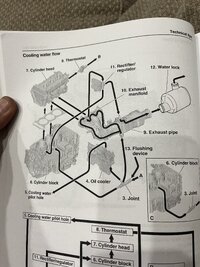
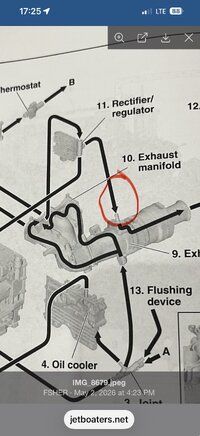
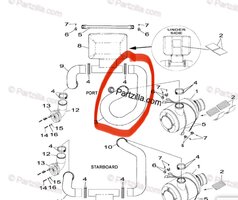
When you mention the mixer, is that the same as the rectifier in the picture. Couldn’t find info on the “mixer”.

The water lock did have salty water in it, am I not flushing long enough?

So to troubleshoot, I can put it on the hose, block off the engine cooling water somewhere and see if it comes out the exhaust pipe? I’m using the picture to attempt to understand.

The anode on the # 1 engine was in rough shape and I took a very long meticulous amount of time to scrape all the residue out of the socket. Could some of that debris dislodged itself and blocked a passage somewhere?
 

Attachments

  • IMG_8679.jpeg
    IMG_8679.jpeg
    2.2 MB · Views: 33
It’s where the rectifier dumps into.

IMG_0716.jpeg


Yes it’s possible for debris to block a passage.
 
It’s where the rectifier dumps into.

View attachment 245054


Yes it’s possible for debris to block a passage.
I really appreciate the help on this one. This is my second boat so I’m still leaning. I feel like I did when I bought my first car, clueless.

I’m going back to the boat today but I’m not sure how to test the water flow with the engine off and water lock disconnected.

There was water in the resonator, the wet tubes and the water lock. That area did have standing water that must have been pretty high. I did manually run the bilge pump when we were getting towed and it did spit out water for about 20 seconds maybe?

But how much water should flow through the mixer, approximately?

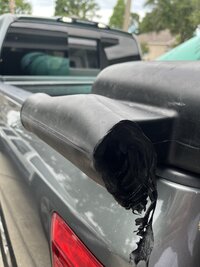
Lastly, what are your thoughts on the bulge on the top of the resonator? In addition why not just straight pipe it?
 

Attachments

  • IMG_8681.jpeg
    IMG_8681.jpeg
    1.4 MB · Views: 22
I think the bulge on the resonator is related to the melted end, the exhaust gasses were so hot it caused the leading edge to melt, and it softened the rest of it, its interesting that bulge is in the cent of the inlet of the resonator, probably the weakest point of the structure. This all happened, IMHO, due to a loss of cooling water to the exhaust.

I have no idea how much water should flow into the mixer, sometimes referred to as a mixing elbow, and I do not know how it functions but my guess would be the water comes in as a spray around the circumference to broadcast that spray as thoroughly as possible into the hot exhaust gas.

Well, since you have the exhaust disconnected, you could figure out a way to flush the mixer, then I’d pop the hose off of the cooling plate for the reg / rect and blow back through there to see if you can easily blow air in that way. Once you’ve got things re assembled you can start the engine and make sure there is water flowing through those and through the T fitting of the reg / rect cooling plate to make sure it’s all clear.

The resonator is for sound attenuation, I’m sure without it there will be a drone sound of some sort and the whole thing could possibly be a lot louder.

Keep at it! You’ll figure it out. And, there is the possibility that it might have been a one time thing where the offending obstruction disappeared. Just make sure it’s all working properly and you should be good to go.
 
I think the bulge on the resonator is related to the melted end, the exhaust gasses were so hot it caused the leading edge to melt, and it softened the rest of it, its interesting that bulge is in the cent of the inlet of the resonator, probably the weakest point of the structure. This all happened, IMHO, due to a loss of cooling water to the exhaust.

I have no idea how much water should flow into the mixer, sometimes referred to as a mixing elbow, and I do not know how it functions but my guess would be the water comes in as a spray around the circumference to broadcast that spray as thoroughly as possible into the hot exhaust gas.

Well, since you have the exhaust disconnected, you could figure out a way to flush the mixer, then I’d pop the hose off of the cooling plate for the reg / rect and blow back through there to see if you can easily blow air in that way. Once you’ve got things re assembled you can start the engine and make sure there is water flowing through those and through the T fitting of the reg / rect cooling plate to make sure it’s all clear.

The resonator is for sound attenuation, I’m sure without it there will be a drone sound of some sort and the whole thing could possibly be a lot louder.

Keep at it! You’ll figure it out. And, there is the possibility that it might have been a one time thing where the offending obstruction disappeared. Just make sure it’s all working properly and you should be good to go.
Man, I would be lost without you on this one.

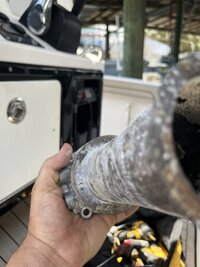
Took the hose off the engine that is connected to the mixer on both engines and blew air through each. #2 engine blew totally fine with no felt restrictions. #1 felt about 80% restricted in comparison. Took what the parts catalog calls a tail pipe off. That’s the part that distributes the water into the exhaust. 2 of the 4 holes were blocked off.

The concern, I cleaned it with fresh water and most of the restrictions cleared up. Not perfectly clear but acceptable. This leads me to believe that not enough water was even getting to the mixer. The tail pipe was covered in salt.

My wife is giving me a couple more hours so we’ll see how far I get.

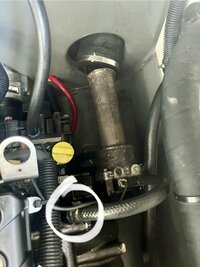
The picture is of the “tail pipe”. Compared to how clean the rest of the engine is, this thing is a mess.
 

Attachments

  • IMG_8682.jpeg
    IMG_8682.jpeg
    1.3 MB · Views: 22
Man, I would be lost without you on this one.

Took the hose off the engine that is connected to the mixer on both engines and blew air through each. #2 engine blew totally fine with no felt restrictions. #1 felt about 80% restricted in comparison. Took what the parts catalog calls a tail pipe off. That’s the part that distributes the water into the exhaust. 2 of the 4 holes were blocked off.

The concern, I cleaned it with fresh water and most of the restrictions cleared up. Not perfectly clear but acceptable. This leads me to believe that not enough water was even getting to the mixer. The tail pipe was covered in salt.

My wife is giving me a couple more hours so we’ll see how far I get.

The picture is of the “tail pipe”. Compared to how clean the rest of the engine is, this thing is a mess.
I asked my marine mechanic friend this morning how long he thought it would take the plastic of the resonator to melt without water reaching the mixer and said about 2 minutes.

Maybe you could soak it in some salt away for a day or two to try and get it totally clean.

Good on you for tearing into it and getting it fixed!

It’s a drag but at least you found the cause!
 
It’s where the rectifier dumps into.

View attachment 245054


Yes it’s possible for debris to block a passage.
After another long day of bloody knuckles and bruised rips I’m feeling beater about resolution but I’m still concerned if water was actually getting to the exhaust and if not, why? And why is there so much salt build up everywhere?

Sadly the picture of the cooling system that im looking at that was from a book that was supposed to be for my make, year and model boat, it does not match what is physically in the boat.

For example the rectifier on my boat only has 2 ports. one on the top and one on the bottom. It does not have the 3rd side port that goes to the mixer in the diagram. The port on my mixer is connected to a hose that if I recall correctly is on top of the header.l, or in that area.

I tried my best to disconnect hoses and simply blow air throw them and then compare each engine. For the most part everything seamed the same. A couple anomalies between the engines but I attribute them to one having the exhaust torn apart and the other completely installed.

At this point I’ve done what I can figure to do. I ordered a new resonator and a muffler gasket and cleaned and sanded the muck off the muffler as best I can.

My plan is to put it together and run it and get some temp readings with my lazer temp gun of everything I can and then compare them to the “good” engine. I’ll also look at the flow out the exhaust and compare them.

I guess I need to run it on the hose for much much longer when I’m flushing it. Normally I’ve only done about 5 mins on each engine.
 
Once you get it back together, I’d Run it on the hose and while it’s running pull the hose off the mixer and make sure you’ve got a good flow of water going to it. Once it’s running for a while water should start to flow out the exhaust.

You may want to run water through the mixer, and put salt away in there as well. From what I understand you want to flush the engines until the thermostat is wide open and flowing full out of the outlet. When you flush the engines, do you flush with clean water then introduce the salt away until you get the foamy stuff coming out and then shut the engine off? You want to leave the salt away in the engines. Go to salt aways web site and read their procedure on how to remove built up salt.
 
Mine is a 2020 and it has the T fitting on the cooling plate for the reg/rect.
 

Attachments

  • IMG_0729.jpeg
    IMG_0729.jpeg
    2.7 MB · Views: 20
After another long day of bloody knuckles and bruised rips I’m feeling beater about resolution but I’m still concerned if water was actually getting to the exhaust and if not, why? And why is there so much salt build up everywhere?

Sadly the picture of the cooling system that im looking at that was from a book that was supposed to be for my make, year and model boat, it does not match what is physically in the boat.

For example the rectifier on my boat only has 2 ports. one on the top and one on the bottom. It does not have the 3rd side port that goes to the mixer in the diagram. The port on my mixer is connected to a hose that if I recall correctly is on top of the header.l, or in that area.

I tried my best to disconnect hoses and simply blow air throw them and then compare each engine. For the most part everything seamed the same. A couple anomalies between the engines but I attribute them to one having the exhaust torn apart and the other completely installed.

At this point I’ve done what I can figure to do. I ordered a new resonator and a muffler gasket and cleaned and sanded the muck off the muffler as best I can.

My plan is to put it together and run it and get some temp readings with my lazer temp gun of everything I can and then compare them to the “good” engine. I’ll also look at the flow out the exhaust and compare them.

I guess I need to run it on the hose for much much longer when I’m flushing it. Normally I’ve only done about 5 mins on each engine.
How did things turn out?
 
How did things turn out?
Hey,

So I got a little obsessed and was politely ask to back away for a moment by my wife. She didn’t grow up with boats and seems confused that they require, at times, as much of your time off the water as you spend on the water.

I was authorized to work on it today while she drank her best red wine and watched murder mysteries.

Everything went back together in the same manor it was taken apart. Lots of blood and lots of F bombs. First I ran the #2 engine for 10 mins or so and pulled cooling lines to check the flow of a “good” engine. Filled it with salt away and moved on to #1. Pulled the same lines and everything looked the same as the other engine. The pilot flow, exhaust and water outcome jet all looked good.

However I did find a tear in the flexible wet pipe that connects the resonator to the water lock. The more i think about that pipe the more I suspect it to be the cause of all the problems.

I noticed a month or more ago the bilge pump would kick out a water after an hour or so of driving. Not a ton of water and I did slowly look at other areas each time I went out. But never made it to the exhaust until now. I found the tear after I ran the engine i noticed salt away colored water in the bilge. So I double checked all my connections a sure enough felt a tear that was dripping water.

Tear must have got progressively worse and less water was entering the resonator and that hot exhaust eventually melted it. New wet pipe on the way at only $340.

Until then I’m planning on temporarily sealing the tear just so I can flush it a couple more times. I figure since I haven’t been flushing it 100% correctly I’d like to just do it a few times and let the solution sit for a day or so, rinse it then flush then repeat. It can’t hurt. At least I’ll have peace of mind.

I appreciate the help on this one it definitely pushed me in the right direction.
 
Sounds like progress! As long as you’ve got water flow through the mixer everything should be good to go!
 
Hey,

So I got a little obsessed and was politely ask to back away for a moment by my wife. She didn’t grow up with boats and seems confused that they require, at times, as much of your time off the water as you spend on the water.

I was authorized to work on it today while she drank her best red wine and watched murder mysteries.

Everything went back together in the same manor it was taken apart. Lots of blood and lots of F bombs. First I ran the #2 engine for 10 mins or so and pulled cooling lines to check the flow of a “good” engine. Filled it with salt away and moved on to #1. Pulled the same lines and everything looked the same as the other engine. The pilot flow, exhaust and water outcome jet all looked good.

However I did find a tear in the flexible wet pipe that connects the resonator to the water lock. The more i think about that pipe the more I suspect it to be the cause of all the problems.

I noticed a month or more ago the bilge pump would kick out a water after an hour or so of driving. Not a ton of water and I did slowly look at other areas each time I went out. But never made it to the exhaust until now. I found the tear after I ran the engine i noticed salt away colored water in the bilge. So I double checked all my connections a sure enough felt a tear that was dripping water.

Tear must have got progressively worse and less water was entering the resonator and that hot exhaust eventually melted it. New wet pipe on the way at only $340.

Until then I’m planning on temporarily sealing the tear just so I can flush it a couple more times. I figure since I haven’t been flushing it 100% correctly I’d like to just do it a few times and let the solution sit for a day or so, rinse it then flush then repeat. It can’t hurt. At least I’ll have peace of mind.

I appreciate the help on this one it definitely pushed me in the right direction.
What is the wet pipe?
 
What is the wet pipe?
Yamaha calls it an exhaust hose. It’s a flexableish hose that’s connects the resonator to the water lock.
 

Attachments

  • IMG_8729.jpeg
    IMG_8729.jpeg
    142.4 KB · Views: 12
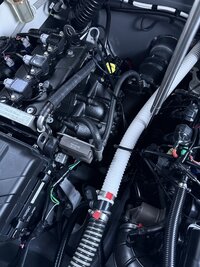
Mine is a 2020 and it has the T fitting on the cooling plate for the reg/rect.
Interesting, mines a 2021, so that must be the year they decided to change it.

I don’t have any great pictures but where yours comes off the tee fitting and goes to the exhaust you can sort of see where mine comes off the engine and goes to the exhaust. This pic the exhaust is half taken apart.
 

Attachments

  • IMG_8724.jpeg
    IMG_8724.jpeg
    733.9 KB · Views: 14
Back
Top