• Welcome to Jetboaters.net!

    We are delighted you have found your way to the best Jet Boaters Forum on the internet! Please consider Signing Up so that you can enjoy all the features and offers on the forum. We have members with boats from all the major manufacturers including Yamaha, Seadoo, Scarab and Chaparral. We don't email you SPAM, and the site is totally non-commercial. So what's to lose? IT IS FREE!

    Membership allows you to ask questions (no matter how mundane), meet up with other jet boaters, see full images (not just thumbnails), browse the member map and qualifies you for members only discounts offered by vendors who run specials for our members only! (It also gets rid of this banner!)

    free hit counter

Low Voltage / Engine Fault / NOCO Install 2026 252SD

I'm creating this new thread to compile a discussion I've been having over a few different threads, and to give someone one place to go to for future questions and help with low battery voltage in an E-Series Yamaha and/or wanting to install a smart charger. There seems to be countless mentions of electrical issues throughout the forums here, but they all seem to be tied to other titles and issues.
......

I plan to catalog the details of this installation for an absolute newbie, so others who are more mechanically challenged, like me, can have a good reference.

Not sure if you can close responses as you're working through this, since your stated goal was ignored in lieu of the many OTHER threads crapping on a manufacturer

Maybe @Bruce @zipper @Julian @Admin can clean this up and separate out the detritus, including my own contributions, so your stated goal can be dragged, kicking and screaming, back on track
 
I
“charged the battery at 100 amps which is TWICE the recommended charge rate of 50 amps.”

Straight to the point but the battery shouldn’t let this happen. Listen ul standards mean crap these days. Many other ul devices still have problems. Idk if you have skin in the game here but I don’t and I’m looking from the outside as a consumer.

I’m not gonna touch that brand with a ten foot pole and I’m not gonna recommend them to anyone. If you watch any other videos and compare the quality it’s obvious. Their design and quality is dated and garbage. Times have moved on and money can be spent on better brands.
To use your turn of phrase, straight to the point. Your original “warning” post was at 0209 hours wherein you basically told @WiskyDan that his battery had a “huge safety issue”.

At 0545 hrs Zipper responded to you with instructions to go and read a thread about the bb batteries and other lfp batteries wherein there has been extensive discussion on this subject of the alleged safety issue. Had you read through that thread you would have seen @WiskyDan post in that thread as well, and his opinions on that u tube hit piece you mention, and, you could have edited and tempered your comments a bit, but you did not.

At 0724 hrs @WiskyDan made post with no comments directed personally at you, his comments were directed at wp and the others on u tube with their comments.

At 0740 hours you responded to my original reply to you where it was obvious you had either not read @WiskyDan ’s post or just ignored it. You went on in this post to completely ignore the factual representation of wp’s own followup testing that proved there was not safety issue with the battery, the battery performs as designed to protect itself from a radical instance of customer abuse and then wp had to switch to another claim that the bb did not fulfill its promises of continuous duty cycle while at a repeated max output and input and backed this claim up with an air cooled inverter that would have overheated and shut down just as the bb battery did if it was in an enclosed space and not in open air. Then you went to say that UL standards mean nothing, then made an accusation towards me, “Idk if you have skin in the game here but I don’t and I’m looking from the outside as a consumer”, which, further confirms that you did not read the thread zipper pointed you towards lest you would have seen that I looked at several battery brands in my research, just as @WiskyDan told you, AND, when wp’s u tube came out I did indeed go out and check my batteries and found that there were no problems with my batteries. I will assert that of all the people on this web site, I have used my BB LFP batteries at a duty cycle that is at least 4 times the average user on this web site, so I have real world experience and use of my bb batteries. I also have 30 years of experience in the electrical field that ranges from industrial oil field and refinery as well as the utility industry of which real world fault analysis was a big part of my career, @WiskyDan pointed this out to you but you ignored that as well.

In other words, you came here as a new member, made an accusation then refused to read any of the materials listed herein, and have also ignored the fact based comments. 🙉 🙈

Your rebuttal to my post #11 was 59 minutes after I posted my response to your claim that bb batteries are not safe. Wherein I listed the facts that clearly show that wp’s u tubes not only contradicted themselves but lacked proper scientific principles. Proper scientific principle goes like this, you start out with a hypothesis, in this case a bad bb battery of unknown origin with damage and that the battery is somehow unsafe. Next you would obtain a pristine undamaged battery as a CONTROL and conduct tests on it, you would test it with the proper size conductors and fasteners torqued properly per the manufacturers instructions to see if it performed as stated. Then you would apply currents to the battery both max discharge and max recommended charge currents taking care to monitor temperatures carefully with a spot radiometer of both the battery case as well as the terminals. Wp sort of did that as far as discharge currents, and even at two times the recommended input current the battery terminals did not show excessive heating, BUT, he did not clarify which terminal was hotter, the positive terminal or the ground terminal, which was the whole point of this exercise, to show that the positive terminal was getting hot, it was not in fact it was cooler than the negative terminal, but only careful observance of wp’s video reveals that, he purposely did not say which terminal was which to try and maintain his original claim. Then you would introduce the VARIABLE which in this case was charging at two times the recommended charge rate to see what the outcome would be. What did his testing prove? There was no safety issue with the BB battery. But, wp did not conduct the tests using the manufacturers specs, don’t you find that interesting? I sure do. I will further state that had he conducted those tests at manufacturers max currents, discharge and charge, he would have found that the battery did indeed perform continuously but wp needed to save face and upped the charge current to two times the recommended rate to assure the battery would go into suppression due to high internal heat. That is some blatant hit piece testing if there ever has been and no one in the thousands of comments called that out except me, and yes, I read thousands of those comments, 99.9% of which were laughable at best, pointed that out except me in specific form, others did in so far as that was a ridiculous test that no battery could pass.

As to skin in the game. My skin in the game is the safety of my equipment and to others that would be on my boat, and by extension to those reading the material that I post for others to use here, and that is because I have a responsibility to others to put forth the factual findings of what I have done, and to update those findings should new information come to light. To suggest otherwise is merely an ad hominem attack on my person to somehow degrade the veracity of what I have to say. As Socrates put it, “When the debate is lost, slander becomes to the tool of the loser”.

You have provided no facts to back up your assertions and you cannot because there no facts to back up your assertions, just fear based on the original u tuber who later did a follow up u tube with an extreme torture test that only proved that there is nothing wrong with the bb battery, proved what bb had said all along that it was customer misuse with the original battery of unknown origin that had that damage.

 
I hope to get to the boat this week to mount the NOCO to the boat (unless I go with the bamboo board option). When I'm doing it, I might go ahead and do the DVSR mod. I read through prior threads today until my eyes were blurry, including these posts:

Making DVSR Active with Engines On Only
Help with dvsr loop sense wire
Moved Batteries today!
Installing 3 bank charger on 2016 e-series

I see there are many options, including tying the dead end of that red loop to something that will power it when the engine is running (my wording, not technically correct verbiage), adding a switch, and adding a relay.

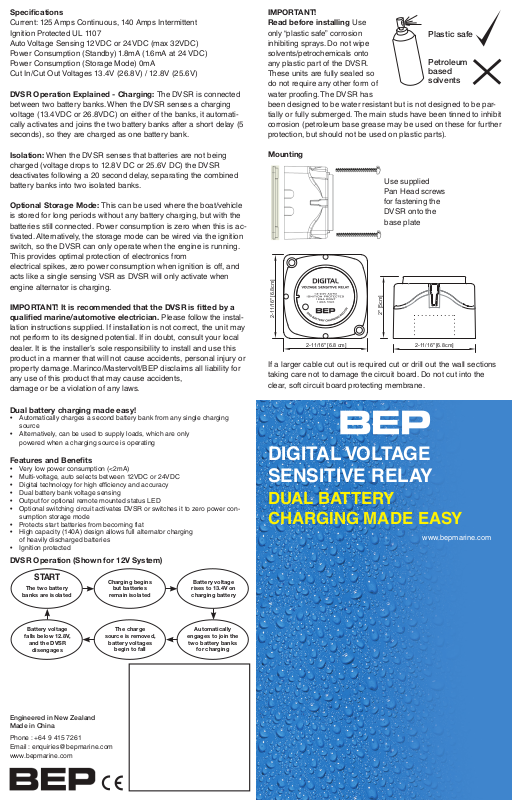
I have two flooded lead-acid batteries on the boat. I keep the boat out of the water. But there will be some weekends where I'll keep the boat in the water for one to two nights in a row. Sometimes, when in the water, I can get it connected to shore power, but not always. With all that in mind, I think the best option is to go with @Yammi's post #4 from FSH 210 and noco 5x2 charger. Based on the above info on my boat, can anyone confirm that's the best route to keep the DVSR as automated as possible?

What additional tools will I need? Remember, I am a rookie:
What do I need to "tie off" the end of the red wire I don't use?
What is the name of the wire adapater that will then connect to the nut? "Wire and nut connector" search on Amazon just brings up the twisty wire connectors you use when you change a ballast.
Any other things I'll need so I can buy it before going to the boat? Any kind of crimping device, etc.?
Thanks for the help, so I don't have to go in and bug the lady at Lowe's who usually helps me with my elementary house repair questions.
 
I see there are many options, including tying the dead end of that red loop to something that will power it when the engine is running (my wording, not technically correct verbiage), adding a switch, and adding a relay.

I have two flooded lead-acid batteries on the boat. I keep the boat out of the water. But there will be some weekends where I'll keep the boat in the water for one to two nights in a row. Sometimes, when in the water, I can get it connected to shore power, but not always. With all that in mind, I think the best option is to go with @Yammi's post #4 from FSH 210 and noco 5x2 charger. Based on the above info on my boat, can anyone confirm that's the best route to keep the DVSR as automated as possible?

That is the perfect way to set up the DVSR when using two lead acid batteries.

What additional tools will I need? Remember, I am a rookie:

What do I need to "tie off" the end of the red wire I don't use? Just a piece of heat shrink will do.

What is the name of the wire adapater that will then connect to the nut?

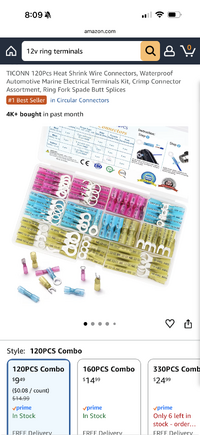
It’s called a ring terminal. You’ll need one for 18 GA wire and you’ll have to determine what size the ring will need to be.

Any other things I'll need so I can buy it before going to the boat? Any kind of crimping device, etc.?

You should be able to find a kit with various types of connectors, spades, butt splices, ring terminals etc that will come with a crimping tool.
 
adding to @FSH 210 Sport response.

When looking for the ring terminals, I like the ones with shrink tubing. You can use a heat gun or a lighter to heat the tubing after crimping it.

So in essence, you will need a flashlight, screw driver to remove the battery switches, a socket set to loosen the nut on the back of the battery switches (if I recall, most wrenches will not work as the nut is recessed), a way to cut the red wire on the DVSR (can be pliers, a knife or a wire cutter), the ring terminal and a wire stripper/crimper. For the 2nd half of the red wire you will want to seal that with electrical tape or liquid electrical tape. If using the ring terminal with the shrink wrap, a heat source.

When I did mine, I needed to push through some slack on the cables from the engine compartment such that I could get the battery switch to rotate so I could work on it.

1778976645496.png
 
adding to @FSH 210 Sport response.

When looking for the ring terminals, I like the ones with shrink tubing. You can use a heat gun or a lighter to heat the tubing after crimping it.

So in essence, you will need a flashlight, screw driver to remove the battery switches, a socket set to loosen the nut on the back of the battery switches (if I recall, most wrenches will not work as the nut is recessed), a way to cut the red wire on the DVSR (can be pliers, a knife or a wire cutter), the ring terminal and a wire stripper/crimper. For the 2nd half of the red wire you will want to seal that with electrical tape or liquid electrical tape. If using the ring terminal with the shrink wrap, a heat source.
This is the exact kind of detail I'm talking about!
 
Do I need to disconnect the leads from the batteries before cutting the DVSR wire, or is keeping the battery switches off enough (in terms of not shocking myself or damaging anything)? When testing the voltage of the snipped wire, I know the leads would need to be plugged in, or neither side would show voltage.

Once I snip the red wire, when I test the voltage to make sure I'm connecting the dead one, I know I should put the red voltmeter lead to that wire. Does the black voltmeter lead need to be touching a ground, also touching the red wire, or something else?
 
Do I need to disconnect the leads from the batteries before cutting the DVSR wire, or is keeping the battery switches off enough (in terms of not shocking myself or damaging anything)? When testing the voltage of the snipped wire, I know the leads would need to be plugged in, or neither side would show voltage.

Once I snip the red wire, when I test the voltage to make sure I'm connecting the dead one, I know I should put the red voltmeter lead to that wire. Does the black voltmeter lead need to be touching a ground, also touching the red wire, or something else?
Battery switch in the off position should suffice, but if you want to be certain you can disconnect at the batteries.

At least in my mind, you have minimal risk of creating an arch while working on the switch as there are no grounds present, and there should be no draw with everything powered down. Someone please correct me if this is not the case.

From my experience, for a 12v multimeter/voltmeter to measure voltage, you have to have a ground present. Alligator clips can be your friend here.

In another note, if you eventually add the smart shunt, you will need another short ground cable to go from one side of the shunt to the negative bus bar. When doing so, I also removed the ground cable that tied both batteries together, as the batteries (at least in my case) were already wired to the same bus bar creating a common ground there. I don’t recall the specifics, but believe the shunt uses a 3/8 lug where most everything else uses a smaller 5/16 lug. Meaning you may need to order a custom cable, or have a heavy duty crimper. I also used this opportunity to put a thicker ground wire in, as I was adding an additional audio amp. Sharing so that if go this route, you can think about current and potentially future needs.
 
I would suggest removing the grounds from the batteries, or whatever sequence the owners manual species on how to remove the batteries. Get some red tape and mark the positive battery cables as well.

The positive terminal(s) on the back of the battery switches on the line side will be energized, so best disconnect the grounds to avoid an accident.
 
I have the same Noco two-bank charger (Odyssey Extreme AGM start & Battle Born Lithium house) and it has worked great so far. I decided to mount it on a bamboo cutting board (cheap at Walmart) so I could easily remove it in the off season to maintain my batteries in the garage.
I showed up to the boat this morning to drill the NOCO into my boat, and decided to go your route.
Why bamboo? Anything special about its water-repelling categories, or is that just what you happened to pick up?
Do you happen to have any pictures of the install? Any recommendation on what kind of VELCRO, or just the meanest looking 3M I can find?
I have enough room to lay the Noco charger down in my battery compartment (some may not) and put a couple strips of Velco (rough side) on the back which keeps it secured to the carpet. Looks like you would have room to mount it this way on the side of the battery compartment where the carpet is?
The outboard and inboard side of that compartment has carpet on it. I'm going to try to stick it on one of the sides, but I wonder if it will be too heavy. Worst case, it won't fall far, and then I can stick it to the deck.
I strongly second the Victron Smart Shunt which works great and allows you to check voltage of both batteries using an app on your smartphone and to also see the charging info in real-time when you plug in your Noco.
You and @FSH 210 Sport have talked me into it. I'll probably try to mount that to the board as well. Do you have Victron Shunt in the same compartment, or back with the batteries?
 
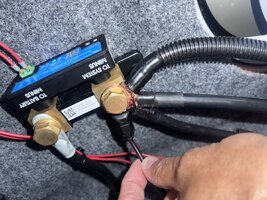
I removed the battery switch housing and looked at the back. If I snip the red wire close to the end, I will have enough length to connect it straight to the ring terminal. Does anyone know if the side of the wire that does not have voltage is always the bottom one? If that is the case, I'll cut it near where the top wire goes into it, so I have the length I need. But if I cannot confirm that before snipping, then I run the risk of making the other one too short and more difficult to splice. If I do need to get some wire to extend it, are there any general rules about needing to keep the gauge the same, or is it better to go bigger?

Other than that, I'll just have to take off the bus on the forward end of the engine compartment to give the top part enough slack to pull the battery switch housing to make the modification. It appears pretty easy. I confirmed today that pre-mod, the red DVSR light is on when the NOCO is plugged in and charging.

I bought a kit of eyelets and butt splice connectors at West Marine. But at @VitaminSea's recommendation, I am going to get the heat-shrink version. I think that will protect it more from corrosion. And bonus, that set is cheaper.

Should I put any dielectric grease, Yamashield, FluidFilm, or anything else on the wire after I snip it but before I splice?
 
If I snip the red wire close to the end, I will have enough length to connect it straight to the ring terminal. Does anyone know if the side of the wire that does not have voltage is always the bottom one? If that is the case, I'll cut it near where the top wire goes into it, so I have the length I need. But if I cannot confirm that before snipping, then I run the risk of making the other one too short and more difficult to splice.
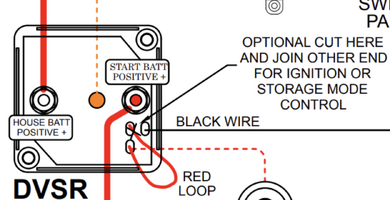
Found the answer! Zooming in on this diagram that's been passed around this forum several times, the diagram shows where to cut and says to "join other end." Notice the X is not in the middle of the wire. So I guess I only need to make the top part long enough to be able to put a heat shrink butt connector on it to close it off. Or electrical tape. Any recommendations on what is best for that?
However, I'll probably leave enough length to splice just in case that is the end I need to connect.
 

Attachments

  • Join Other End.png
    Join Other End.png
    361.6 KB · Views: 3
Here are the directions.

I’d cut it in the middle and put a piece of heat shrink over the end that’s not used. Just fold the end of the wire over, slip the heat shrink over the doubled over wire leaving a 1/8th of inch of heat shrink hanging over, heat and forget.

DO NOT put anything on the bare wire before splicing on another piece of wire. Put some heat shrink over the wire before you splice then you can slide it up over the splice and shrink it around the splice.
 
I showed up to the boat this morning to drill the NOCO into my boat, and decided to go your route.
Why bamboo? Anything special about its water-repelling categories, or is that just what you happened to pick up?
Do you happen to have any pictures of the install? Any recommendation on what kind of VELCRO, or just the meanest looking 3M I can find?

The outboard and inboard side of that compartment has carpet on it. I'm going to try to stick it on one of the sides, but I wonder if it will be too heavy. Worst case, it won't fall far, and then I can stick it to the deck.

It was what they had at the time and it was closest to the size of the Noco chassis - I have limited space. I bought the heavy duty Velcro and I don't think it will move if you put it on the side wall which doesn't look completely vertical. Let me look for some photos.........

You and @FSH 210 Sport have talked me into it. I'll probably try to mount that to the board as well. Do you have Victron Shunt in the same compartment, or back with the batteries?

I have it in the same compartment but it is mounted to the wall - you would need to remove a couple of wires and the battery cables from it if you want to take it out at the end of the season. I'll check for photos on this as well......
 
Last edited:
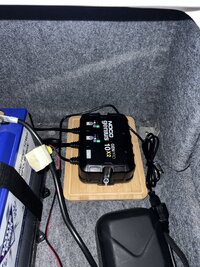
Here's the Noco position:

IMG_6821.jpeg

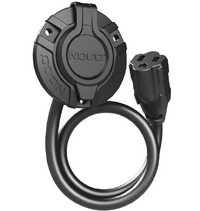
I screwed the Smart Shunt to the inside wall of the battery compartment at roughly the position of the red star. The green star is where I drilled the hole for the Noco electrical port plug. Some people have mounted the port plug on an external surface but I wanted to keep it away from the elements.

SbuNm5W49W_hLQVm2Oqn5p2Iood77CEBIJiD123PK4WK8uxl_gi6MN_iMynD15zZzKl8EVeaMmVyGmt3kfy3LtBq6JCKE...jpeg

Electrical port plug

noco port.png

Smart Shunt position - I might buy longer battery cables and move it to the side wall directly above the charger at some point.

IMG_6721.jpeg
 
As far as I am aware, another method of allowing the charger to charge batteries independently is adding a switch to the black negative wire coming off the DVSR. That is how I have mine hooked up and it is working fine but you must use a low resistance switch. When the switch is closed it should read around .005 ohms. A high resistance switch will cause issues. For me that was easier and quicker than removing the DVSR to access the back side.
 
As far as I am aware, another method of allowing the charger to charge batteries independently is adding a switch to the black negative wire coming off the DVSR. That is how I have mine hooked up and it is working fine but you must use a low resistance switch. When the switch is closed it should read around .005 ohms. A high resistance switch will cause issues. For me that was easier and quicker than removing the DVSR to access the back side.
Thanks. Is there any chance you have a picture of that switch installed?
 
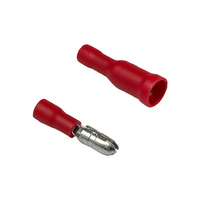
i'm probably a bogan......but i just cut the dvsr black ground wire and put male/female bullet connectors on the wire. i just disconnect them when i plug my charger into shore power, connect them when i unplug the charger from shore power...no switch needed.

1779157895816.png
 
you would need to remove a couple of wires and the battery cables from it if you want to take it out at the end of the season.
There is no "end of season" where I am 😏. We bought the boat in October and used it through the "winter," including Thanksgiving and Christmas day.
 
Back
Top